

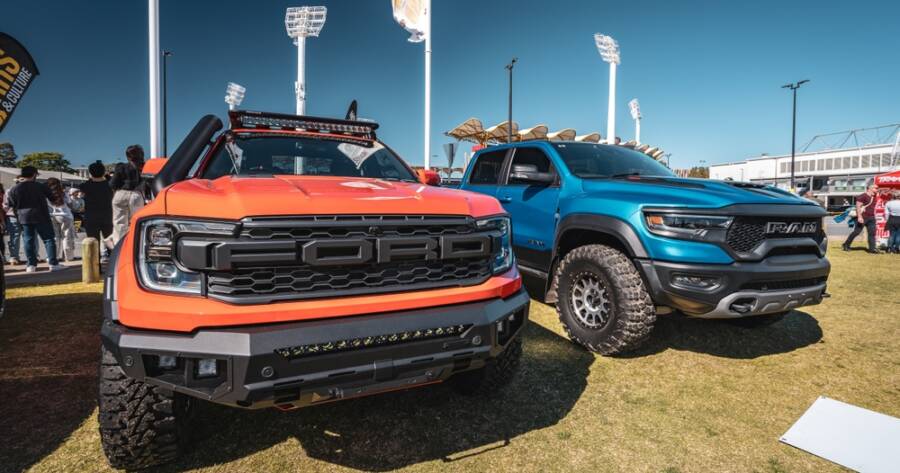
Two of America’s most popular pickup trucks, the Ford F-150 and Ram 1500, each bring distinct strengths to the table — from powertrain choices and towing muscle to ride quality and advanced technology. Understanding what sets them apart helps buyers make a confident decision.
Powertrain Options and Performance
Both the Ford F-150 and Ram 1500 give buyers access to capable, well-engineered engines, but they take noticeably different paths to deliver that performance. Ford equips the F-150 with a broad selection of powertrains, including a twin-turbocharged 2.7-liter V-6, a twin-turbocharged 3.5-liter V-6, a naturally aspirated 5.0-liter V-8, and the PowerBoost hybrid system that pairs the twin-turbo 3.5-liter V-6 with an electric motor (source). That hybrid configuration produces a combined output of 430 horsepower and 570 pound-feet of torque (source).
Ram answers with its Hurricane twin-turbocharged 3.0-liter inline-six engine, which generates 420 horsepower and 469 pound-feet of torque (source). While both engines deliver strong on-road performance, the F-150 PowerBoost holds a measurable advantage in peak torque output — a figure that matters when hauling heavy loads or towing large trailers. In timed testing, the F-150 outpaced the Ram through the quarter-mile, though only by a tenth of a second, illustrating just how closely matched these trucks are when pushed hard (source).
Towing and Hauling Capability
For buyers who rely on their truck for heavy-duty work, towing capacity ranks among the most important considerations. Ford promotes the F-150 as having best-in-class towing capabilities among half-ton trucks, a benchmark that positions it as one of the most capable full-size pickups in the segment (source). The range of engine options means buyers can select the level of capability that matches their specific needs, whether that involves occasional light hauling or regular, demanding towing tasks.
The Ram 1500 is no slouch in this department either, as the Hurricane inline-six produces substantial torque that translates well to trailer towing. However, the F-150’s higher peak torque figure — particularly with the PowerBoost setup — gives Ford a statistical edge in scenarios where maximum pulling strength is required. Both trucks carry large fuel tanks exceeding 30 gallons, which allows for driving ranges above 500 miles between fill-ups, an important practical advantage for drivers towing over long distances (source).
Fuel Economy and Efficiency
Running costs matter over the lifetime of any vehicle, and fuel efficiency is a key part of that equation for full-size truck owners. During highway fuel economy testing at 75 mph, the F-150 returned 20 mpg compared to the Ram’s 18 mpg (source). That two-mpg difference may appear modest on paper, but it compounds meaningfully across thousands of miles of driving each year.
The F-150’s hybrid powertrain plays a direct role in achieving that efficiency advantage. Despite carrying additional hybrid hardware, the F-150 actually weighs less than the Ram — 5,631 pounds versus 5,765 pounds — which contributes to both its performance and fuel economy results (source). Achieving a lighter curb weight while incorporating hybrid components reflects strong engineering priorities around efficiency.
Ride Quality and Driving Character
The on-road experience in these two trucks reflects their differing engineering philosophies. The Ram 1500 is available with an optional four-corner air-spring suspension system that delivers a noticeably smooth, cushioned ride — the kind of comfort that appeals to drivers who spend long hours behind the wheel on varied road surfaces (source). For buyers who prioritize passenger comfort above all else, the Ram’s available suspension setup is a compelling feature.
The F-150, by contrast, relies on a conventional coil- and leaf-spring suspension arrangement. While this setup may not deliver the same cloud-like softness as the Ram’s air springs, it provides sharper steering feedback and a stronger sense of driving confidence — qualities that appeal to drivers who want their truck to feel more connected and responsive on the road (source). The choice between the two often comes down to whether a buyer values silky ride compliance or more driver-focused handling.
Technology and Trim Variety
Technology has become a major differentiator in the full-size truck segment, and the F-150 brings a notable advantage in this area. Ford equips the F-150 with BlueCruise, a hands-free driving system that allows drivers to travel on mapped highways without keeping their hands on the steering wheel, positioning the truck among the most technologically advanced options in its class (source). This kind of driver-assistance technology is increasingly valued by buyers who cover significant highway mileage regularly.
Beyond driver assistance features, the F-150 spans a wide trim lineup designed to serve everyone from fleet buyers and tradespeople to buyers seeking premium, feature-loaded configurations (source). The Ram 1500 likewise offers a range of trims with available features like the air suspension, upscale interior materials, and its own suite of infotainment technologies. Together, these two trucks represent the breadth of what the modern full-size pickup market has to offer.
Pricing and Value Considerations
Pricing plays a significant role in any truck purchase decision, particularly when comparing two well-equipped mid-range configurations. In a direct comparison between comparable builds, the F-150 came in at a lower as-tested price than the Ram 1500, with the Ram’s additional cost partly attributable to the optional air suspension package (source). Buyers who want the Ram’s smooth air-spring ride should factor that optional upgrade into their budget from the start.
From a value standpoint, the F-150 offers strong performance, better fuel economy, lighter weight, advanced hybrid technology, and a lower price in this direct comparison. The Ram counters with an exceptionally refined ride and its own powerful Hurricane engine. Depending on the priorities a buyer brings to the dealership, either truck can represent excellent value — the key is matching the truck’s strengths to the owner’s actual use case.
Why You Should Learn More About Ford F-150 and Ram 1500 Today
The Ford F-150 and Ram 1500 represent the pinnacle of half-ton truck engineering, with each model excelling in different areas. The F-150 stands out for its hybrid efficiency, towing credentials, lighter curb weight, hands-free driving technology, and broad trim availability. The Ram 1500 earns praise for its powerful Hurricane engine, plush optional air suspension, and premium interior refinement. Buyers who prioritize driving dynamics and fuel savings may find the F-150 better suited to their needs, while those who prize ride comfort and cabin elegance may lean toward the Ram. Both trucks are serious, capable machines that continue to shape what Americans expect from a full-size pickup. Taking time to explore each model’s full lineup and available configurations allows buyers to make a truly informed choice before visiting a dealership.